An operating system for your life
When the plan breaks, Rewind picks it up.
Every productivity tool helps you make a plan. Rewind, built for people with ADHD, helps when the plan breaks. It detects disruptions, reschedules your day like an OS schedules processes, and drafts the busywork for you.
- 6.1M
- U.S. adults diagnosed with ADHD
- <3s
- from disruption to nudge
- 3-tier
- OS-style scheduler
The Problem
Productivity tools are built for the plan. People with ADHD need help with what happens after it breaks.
Executive dysfunction
Planning isn't the problem
6.1 million adults in the U.S. are diagnosed with ADHD. Diagnosis isn't the hard part. With the executive dysfunction that comes with ADHD, starting can feel impossible even when you know exactly what you need to do. The problem is what happens when the plan breaks.
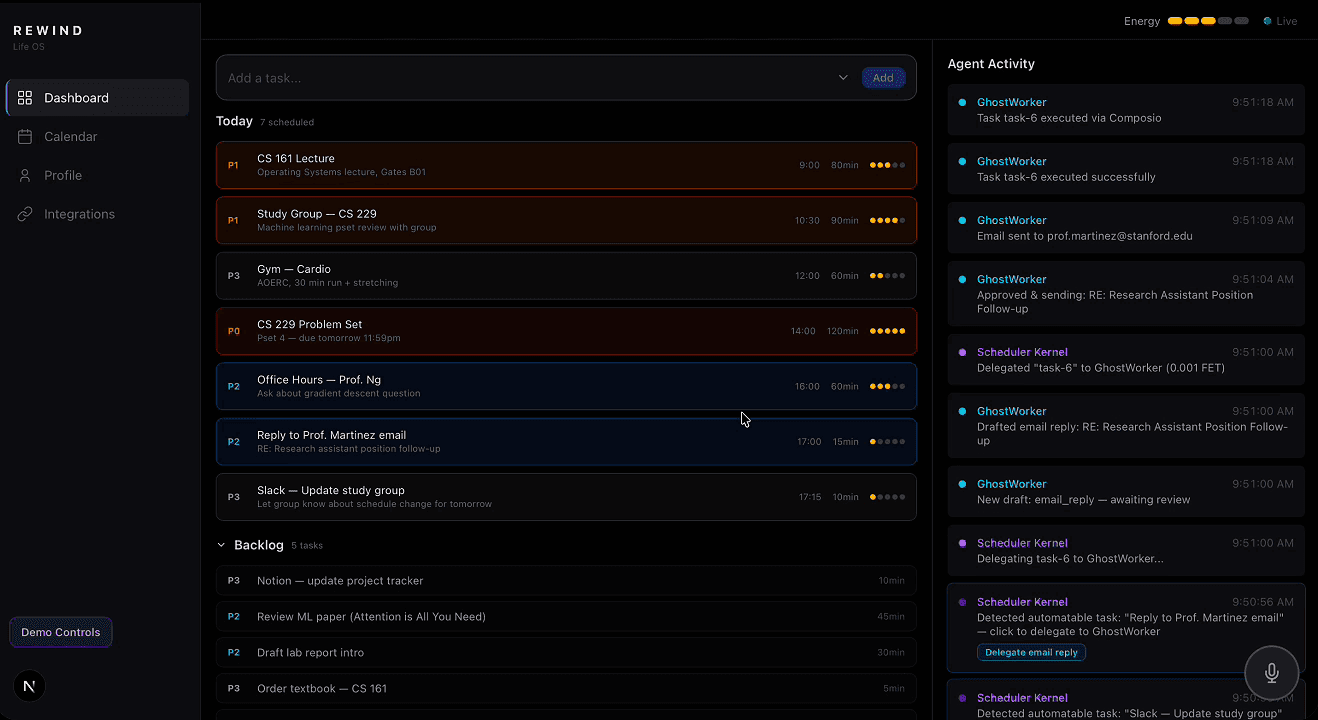
- Reply to Prof. Martinez
- CS 229 problem set
- Gym: cardio
- Update study group on Slack
You know exactly what's next. Starting is the hard part.
Every tool, same flaw
They help you plan, then abandon you
Two members of our team live with ADHD. We've tried every productivity system: Notion databases, time-blocking in Google Calendar, even gamified to-do apps. They all fail the same way: they help you plan, then leave you on your own the moment something goes wrong.
The moment we target
The 15–30 minutes after a disruption
A meeting runs 15 minutes over. You space out for 10. By the time you've replanned, 45 minutes are gone, and your momentum with it. That window after the plan breaks, when you're silently stuck with no idea what to do next, is exactly where Rewind steps in.
- Meeting runs over+15m
- You space out+10m
- Replanning+20m
It's not a willpower problem. It's a working-memory problem.
When processes compete for limited CPU time and interrupts fire unexpectedly, an operating system doesn't panic. It doesn't delete processes when something changes; it reschedules them. Rewind applies the same model to your day.
Long-Term Scheduler
Plans your day. Scores tasks by deadline urgency (40%), priority (30%), peak-hour fit (15%) and duration (15%), then bin-packs them into your available hours, correcting for how much you usually underestimate.
Medium-Term Scheduler
Recovers from disruptions. When time is freed or lost, it swaps tasks between your active schedule and the backlog, and never schedules a task that's beyond your current energy.
Short-Term Scheduler
Picks what you do next. A four-level multilevel feedback queue (P0–P3) lets urgent tasks jump the line while respecting energy constraints.
Built from clinical research
We didn't start from a feature list. Each core workflow targets a specific ADHD challenge documented in clinical research.
Disruption detection
The Context Sentinel watches your Google Calendar, Gmail and Slack. The moment reality diverges from your plan, the Disruption Detector rates it: minor (a meeting ran 5 min over), major (a meeting was cancelled) or critical (an urgent Slack from your manager).
Auto-rescheduling
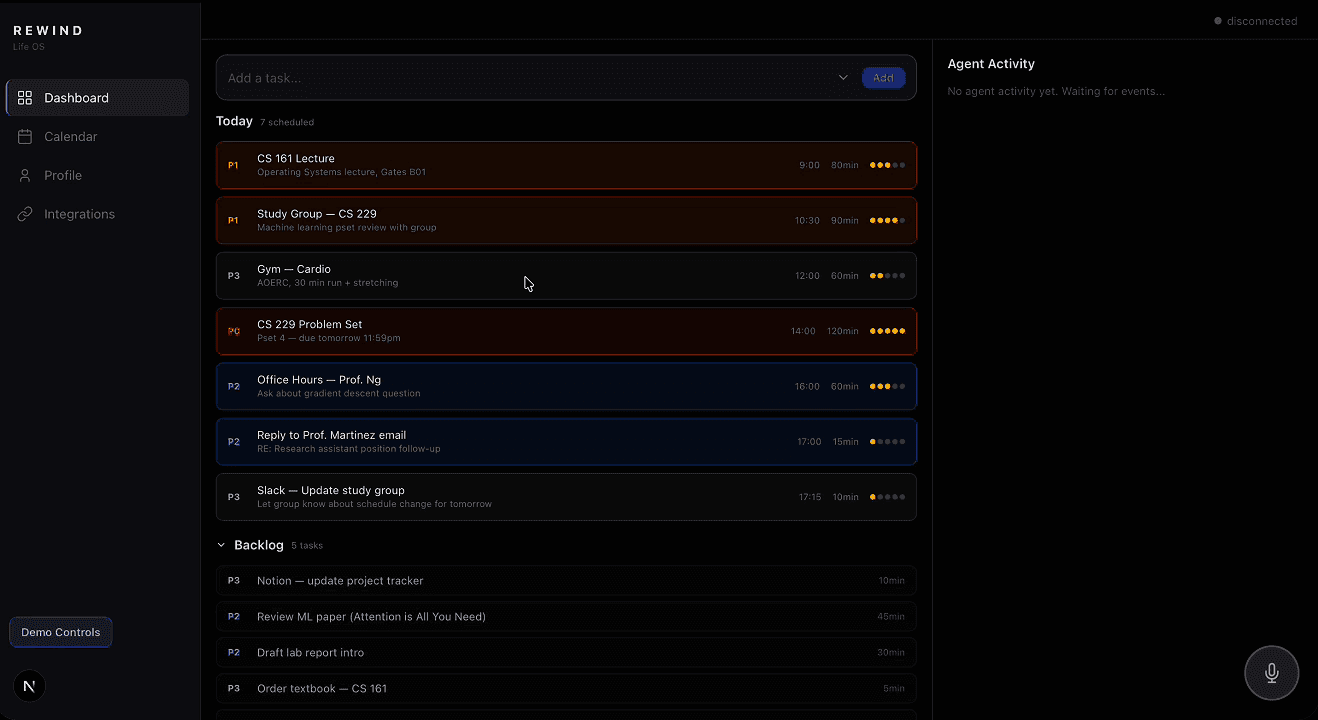
You never replan by hand. The Scheduler Kernel rebalances your day across all three tiers and puts the single next thing to do in front of you.
Estimation correction
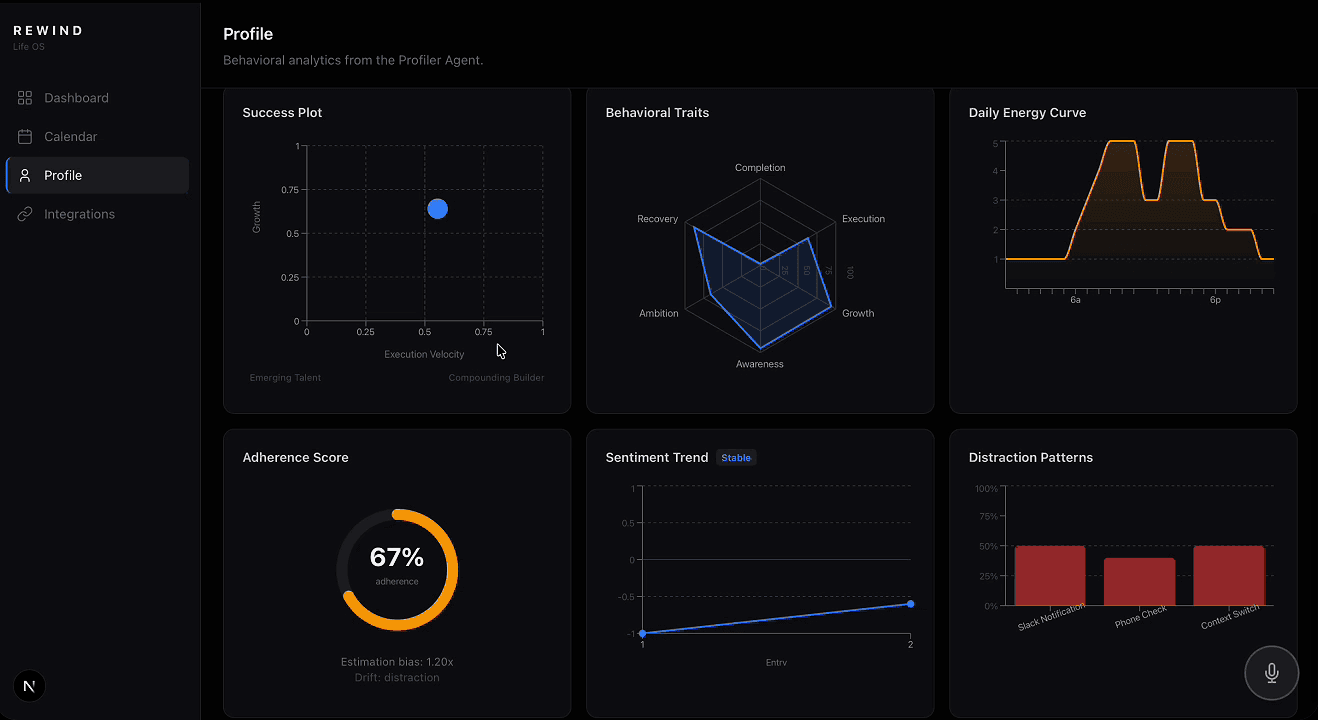
The Profiler Agent learns your actual peak hours (not when you think you're productive) and how much you underestimate tasks, then corrects every plan it makes. It gets smarter with every interaction.
Energy-aware scheduling
The Energy Monitor combines research-backed circadian patterns with how you actually complete tasks. The goal: never assign a task your brain can't handle right now.
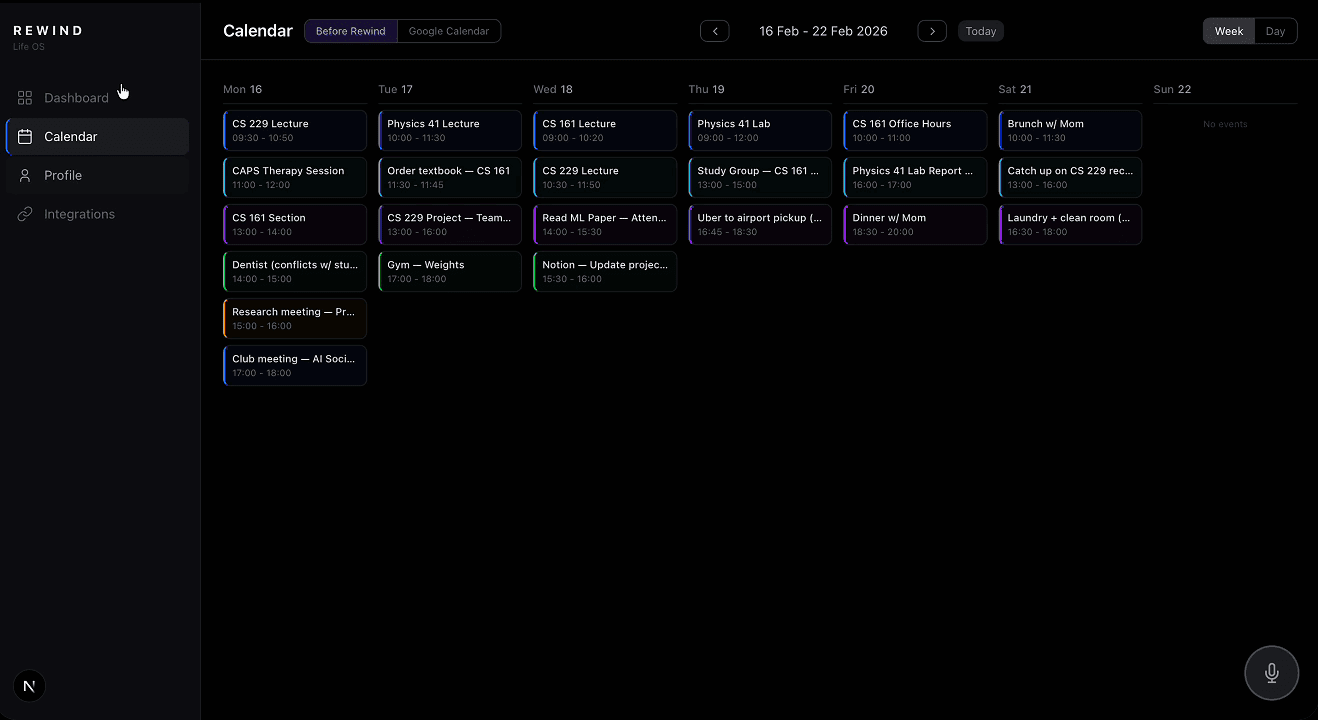
GhostWorker does the busywork
When being proactive can save you from a disruption, GhostWorker drafts the email, Slack reply or meeting reschedule for you. You approve it with one tap.
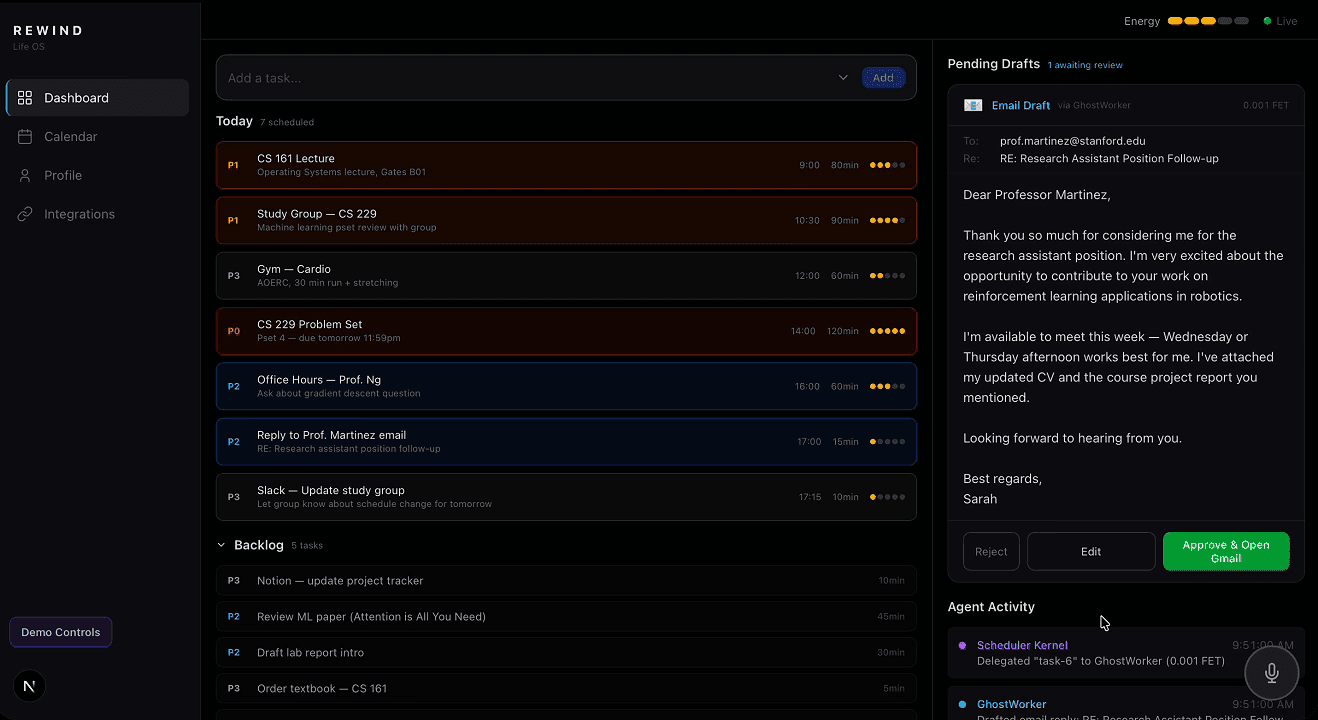
How it works
Seven agents share context and talk to each other. Here's what happens when your meeting runs over.
Context Sentinel
Notices your meeting ran 15 minutes over.
Disruption Detector
Classifies it and calculates the time you lost.
Scheduler Kernel
Swaps tasks out and reorders the rest of your day.
You
See the one next thing to do, in under 3 seconds.
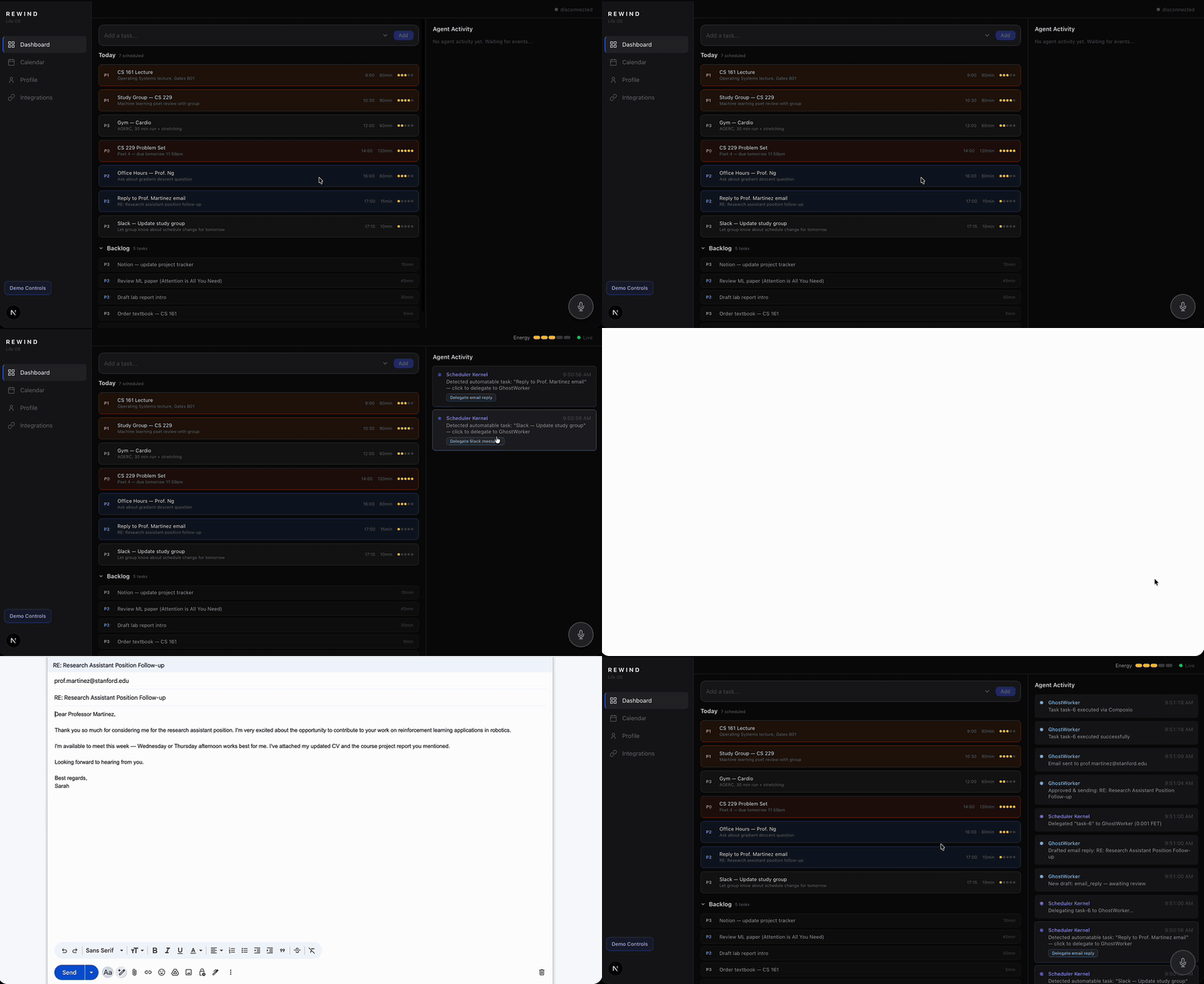
The Scheduler Kernel hands a task to GhostWorker, which drafts the email for you to approve with one tap.
Meet the team.
Two of us live with ADHD. We built Rewind at TreeHacks for the moment the plan breaks.

Saksham Adhikari
- 2x Intern @ AskSLM
- 6x Hackathon Winner
- Google TPU Research Cloud Grantee

Kusum Bhattarai Sharma
- 4x Hackathon Winner
- AI Research @ THRC

Himavanth Karpurapu
- MS CS @ SJSU
- Amazon Web Services ABW Grant Scholar

Pranavi Rohit
- ECE & AI @ CMU
- Agentic AI @ Boeing
Every tool helps you make a plan. Rewind helps when it breaks.
Catch the disruption, replan the day and get back to the next task before momentum is gone.
Open the dashboard